Interactive Business Model Canvas · #062

Tesla
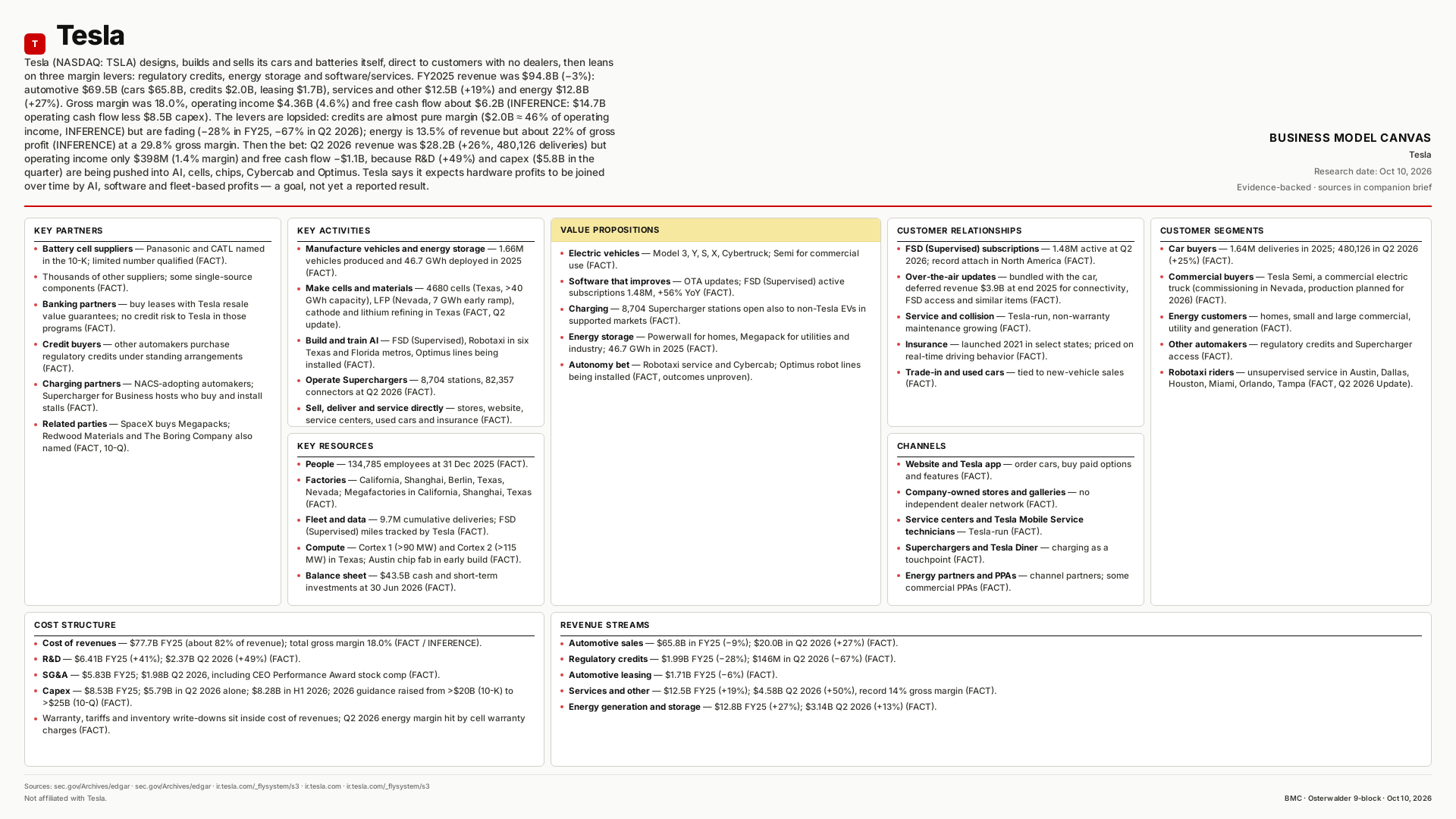
Tesla (NASDAQ: TSLA) designs, builds and sells its cars and batteries itself, direct to customers with no dealers, then leans on three margin levers: regulatory credits, energy storage and software/services. FY2025 revenue was $94.8B (−3%): automotive $69.5B (cars $65.8B, credits $2.0B, leasing $1.7B), services and other $12.5B (+19%) and energy $12.8B (+27%). Gross margin was 18.0%, operating income $4.36B (4.6%) and free cash flow about $6.2B (INFERENCE: $14.7B operating cash flow less $8.5B capex). The levers are lopsided: credits are almost pure margin ($2.0B ≈ 46% of operating income, INFERENCE) but are fading (−28% in FY25, −67% in Q2 2026); energy is 13.5% of revenue but about 22% of gross profit (INFERENCE) at a 29.8% gross margin. Then the bet: Q2 2026 revenue was $28.2B (+26%, 480,126 deliveries) but operating income only $398M (1.4% margin) and free cash flow −$1.1B, because R&D (+49%) and capex ($5.8B in the quarter) are being pushed into AI, cells, chips, Cybercab and Optimus. Tesla says it expects hardware profits to be joined over time by AI, software and fleet-based profits — a goal, not yet a reported result.
Click any of the 9 blocks below for a plain-language story of how that part of the model works for Tesla — and how it connects to the others.
Printable poster
Static handout preview — use Downloads in the top bar for PDF, PNG, poster HTML, or the research brief. The interactive canvas above is the primary experience.